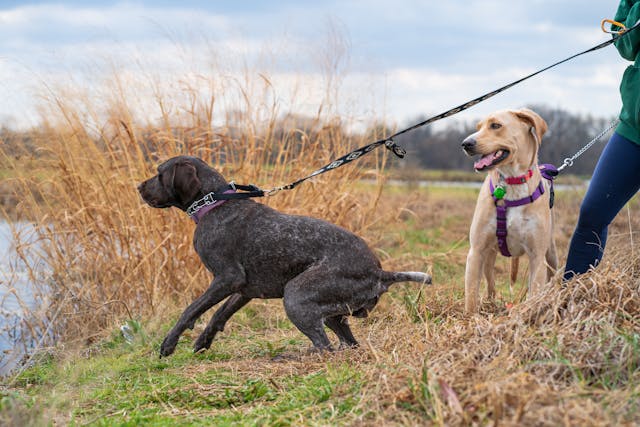
You want those peaceful, enjoyable walks with your dog — but instead, you end up being the one pulled down the street.
Trust me, you’re far from alone. Many dog parents struggle with leash pulling, and changing that behavior takes time, consistency and lots of patience.
If you’re ready to make walks easier for both you and your pup, here’s how to teach your dog to stop pulling and finally enjoy being outside together.
Why Dogs Pull On the Leash
Most dogs pull for one simple reason: it works. If pulling gets them closer to something exciting — a smell, a dog, a tree, a destination — the behavior gets reinforced.
Some pups pull because they’re reactive or overstimulated by other dogs, animals or noises. In these cases, keeping their attention on you becomes even more challenging, but absolutely doable with the right approach.
Another common issue? Using gear that unintentionally encourages pulling, such as retractable leashes that create constant tension.
Where To Start Training
In the beginning, practice in the most boring place possible — a quiet, distraction-free room inside your home. New skills stick better when your dog isn’t overwhelmed by sounds, smells and movement.
Once your dog can walk on a loose leash indoors, slowly introduce harder environments:
- Inside your home
- Your backyard
- Your driveway
- Quiet street
- Regular walking route
You’re building difficulty step by step, not all at once.
Helpful Tools (And Tools To Avoid)
Equipment alone won’t fix pulling — training does. But the right tools can make the process easier.
Front-Attaching Harness
A harness with a front clip helps manage pulling by gently redirecting your dog sideways when they try to surge ahead.
Just make sure you clip the leash to the front, not the back. Attaching it to the back might actually encourage the pulling behavior you don’t want.
Try this harness from Wild One
Or try the Tru-Fit Smart Dog walking harness from Kurgo
Head Halters (Gentle Leaders)
These can help in situations where walking isn’t safe without them — such as very large dogs being walked by smaller people.
They require careful conditioning and shouldn’t be your first option.
High-Value Treats
This is the real secret. Use treats your dog absolutely loves — not dry, boring kibble.
You need rewards that can compete with:
- other dogs
- scents
- squirrels
- the entire outside world
Many dog parents even cook fresh meat in the beginning, then slowly transition to training treats as their pup gets more reliable.
Try Honest Kitchen’s dog training treats from Amazon
Or try Bocce’s Bakery’s training treats from Amazon
Carry your treats in a pouch so you can reward instantly.
Try this Mighty Paw dog training treat pouch from Amazon
Avoid These Tools
Professional trainers strongly discourage:
- prong collars
- choke collars
- shock collars
- spray collars
These rely on pain or discomfort, don’t teach the dog the correct behavior and can create emotional or behavioral issues.
Also avoid walking your dog on a flat collar — it's unsafe for their neck and not designed for leash walking.
How To Train Your Dog To Stop Pulling
Here’s the foundation of loose-leash walking:
1. Reward the behavior you want — a LOT
Any time your dog:
- looks at you
- walks beside you
- checks in with you
… reward immediately.
2. When your dog pulls — stop. Every time.
Stand still.
Call them back.
Ask for a sit if needed.
Reward when they return to you.
This teaches one simple rule: pulling never gets them where they want to go — but staying close to you does.
3. Manage distractions
If your dog is reactive or easily overstimulated, use the environment to help:
- Stand behind a car
- Put a tree or hedge between you and the trigger
- Cross the street
Feed treats while the distraction passes to keep your dog under threshold.
4. Gradually increase difficulty
Your dog might start by sitting across the street from another dog, then progress to passing on the same sidewalk, and eventually walking by while staying focused on you.
This takes time — but it works.
Final Thoughts
Loose-leash walking doesn’t happen overnight. It takes:
- consistency
- patience
- high-value rewards
- and lots of practice in gradually harder environments
But with time, your dog will learn that sticking close to you is the most rewarding part of the walk. And soon enough, you’ll be the pair other dog owners admire — calm, connected and walking together as a team.
We independently pick all the products we recommend because we love them and think you will too. If you buy a product from a link on our site, we may earn a commission.